FAQs
Frequently Asked Questions
Have questions about fine blanking, tooling, production support, or whether Burkland may be a fit for your part? These answers cover common questions from engineers, purchasing teams, program managers, and manufacturers. If you do not see what you need, contact Burkland with your drawing and project details.
What does Burkland manufacture?
Burkland manufactures precision metal components and assemblies for demanding applications. Our work is centered on precision fine blanking, in-house tooling, and supporting operations that help move a part from drawing to production. We work with customers who need dependable quality, consistent production, and close attention to part features such as edge quality, flatness, perpendicularity, dimensional accuracy, and functional performance.
How long has Burkland been in business?
Burkland has been serving precision metal manufacturing customers since 1980. Over the years, the company has built experience producing components for applications where part quality, repeatability, and dependable production performance matter.
How large is Burkland’s manufacturing facility?
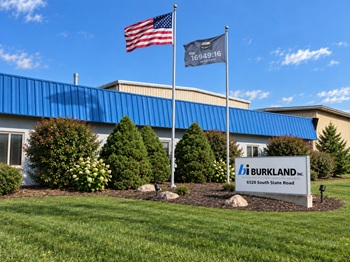
Burkland operates from a 75,000-square-foot manufacturing facility in Goodrich, Michigan. The facility supports precision fine blanking, in-house tooling, quality and inspection, and the production operations needed to serve demanding component programs.
What is fine blanking?
Fine blanking is a precision metal-forming process used to produce parts with clean, fully sheared edges, accurate features, and controlled geometry. It is different from conventional stamping because the material is supported and controlled throughout the operation. For the right part, fine blanking can reduce the need for secondary finishing and help produce consistent components across ongoing production volumes.
How is fine blanking different from conventional stamping?
Conventional stamping can be a cost-effective process for many parts, but it may not be the best fit when a component requires close tolerances, smooth edges, high flatness, or precise perpendicularity.
Fine blanking is often considered when the edge itself is important to how the part fits, moves, engages another component, or performs in an assembly. The right choice depends on the material, part geometry, volume, quality requirements, and intended use of the component.
What types of parts are a good fit for Burkland?
Burkland is well suited for precision metal components that have demanding requirements for edge condition, flatness, perpendicularity, dimensional accuracy, material thickness, or repeatable production performance. Examples may include components used in automotive, heavy truck, industrial, agricultural, construction, defense, consumer, and specialty applications. The best way to determine whether a part is a good fit is to share the drawing and the requirements behind it.
Does Burkland design and build tooling in-house?
Yes. Burkland designs, builds, and maintains tooling in-house. This creates a direct connection between the people supporting the tools and the people producing the parts. In-house tooling helps support new part launches, ongoing production, maintenance, repair, and practical process improvements. It also gives Burkland closer control over the details that affect part quality and consistency.
What additional services can Burkland support?
Depending on the part and program requirements, Burkland may support secondary operations and production services that help deliver a more complete component. These may include approved machining, grinding, staking, deburring, tapping, assembly, finishing, treatment, plating, coating, heat treating, welding, or other value-added work. The specific services available for a project depend on the part requirements and should be discussed during the quote and project-review process.
What industries does Burkland serve?
Burkland supports customers across automotive, heavy truck, industrial equipment, agriculture, construction, defense, consumer products, and specialty applications. Different industries have different performance expectations, but the basic need is often the same: a component that meets specification, performs reliably, and can be produced consistently.
Can Burkland help with a new part design?
Burkland can review a new drawing, existing part, or component concept to help determine whether fine blanking and the available supporting operations are a good fit. The earlier Burkland reviews the part requirements, the better the team can understand material needs, critical features, production volume, tooling considerations, and any quality or inspection expectations.
Can Burkland help with an existing production part?
Yes. If you have an existing production part, Burkland can review the drawing, material, process requirements, and current challenges to determine whether there may be a practical manufacturing solution. This may be useful when a part has issues involving edge condition, flatness, dimensional consistency, unnecessary secondary operations, tooling needs, or overall production efficiency.
What information should I provide when requesting a quote?
The most helpful starting point is a part drawing or CAD file, along with the material specification, thickness, expected annual volume, required timing, and any critical dimensions or features. It is also helpful to include inspection requirements, documentation or traceability needs, finishing requirements, assembly needs, and any challenges you are experiencing with the current part or process.
Does Burkland support quality and inspection requirements?
Yes. Quality and inspection are considered throughout the manufacturing process, from part requirements and tooling through production and final verification. If your project has specific inspection criteria, documentation, traceability, reporting, or quality-system requirements, include them with your quote request so they can be reviewed early in the process.
How do I contact Burkland about a project?
You can contact Burkland through the website contact form, request a quote form, phone, or approved company email address. When possible, include a drawing and the details that matter most to the part so the team can better understand your project.